 +917069001605
 Send Inquiry

 Send Inquiry
Automatic Powder Filling Machine
MOQ : 1 Piece
Automatic Powder Filling Machine Trade Information
- Minimum Order Quantity
- 1 Piece
- Payment Terms
- Cash Against Delivery (CAD), Letter of Credit (L/C), Letter of Credit at Sight (Sight L/C), Telegraphic Transfer (T/T), Cash in Advance (CID), Cheque, Cash Advance (CA)
- Supply Ability
- 30 Pieces Per Month
- Delivery Time
- 4-6 Week
- Sample Available
- Yes
- Sample Policy
- Contact us for information regarding our sample policy
- Packaging Details
- wooden packing only
- Main Domestic Market
- All India
- Certifications
- CE & ISO Certified
Automatic Powder Filling Machine About
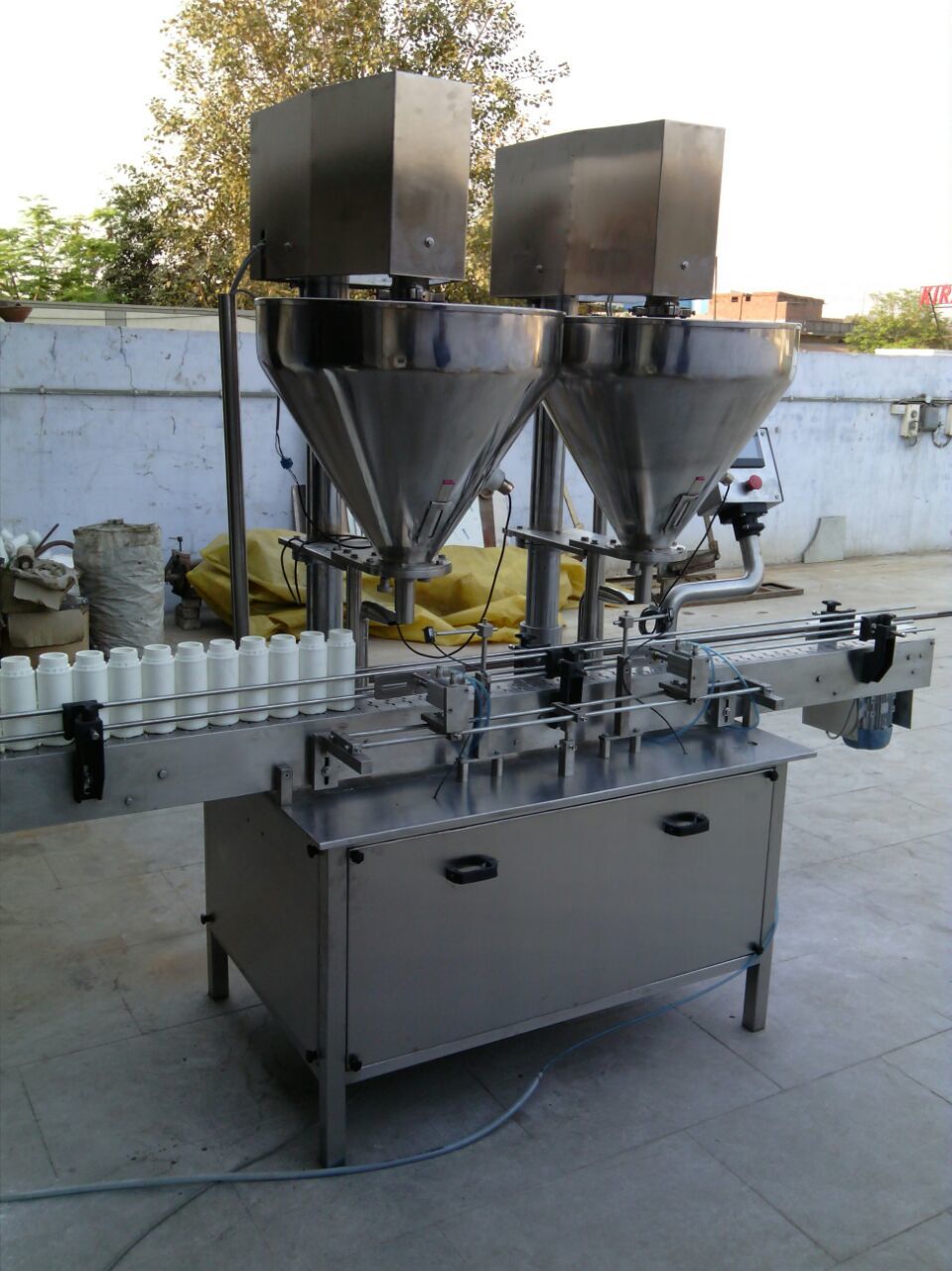
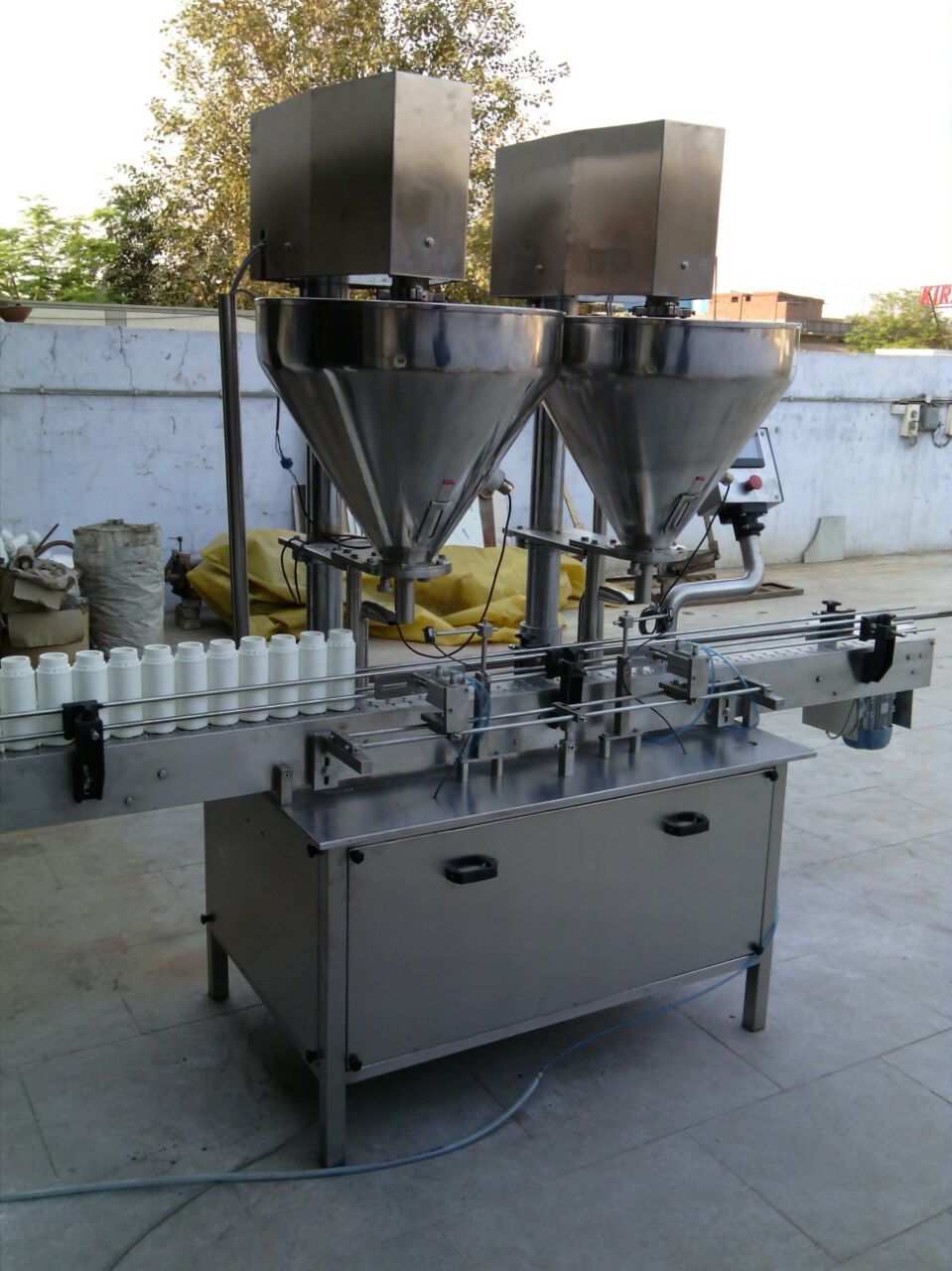
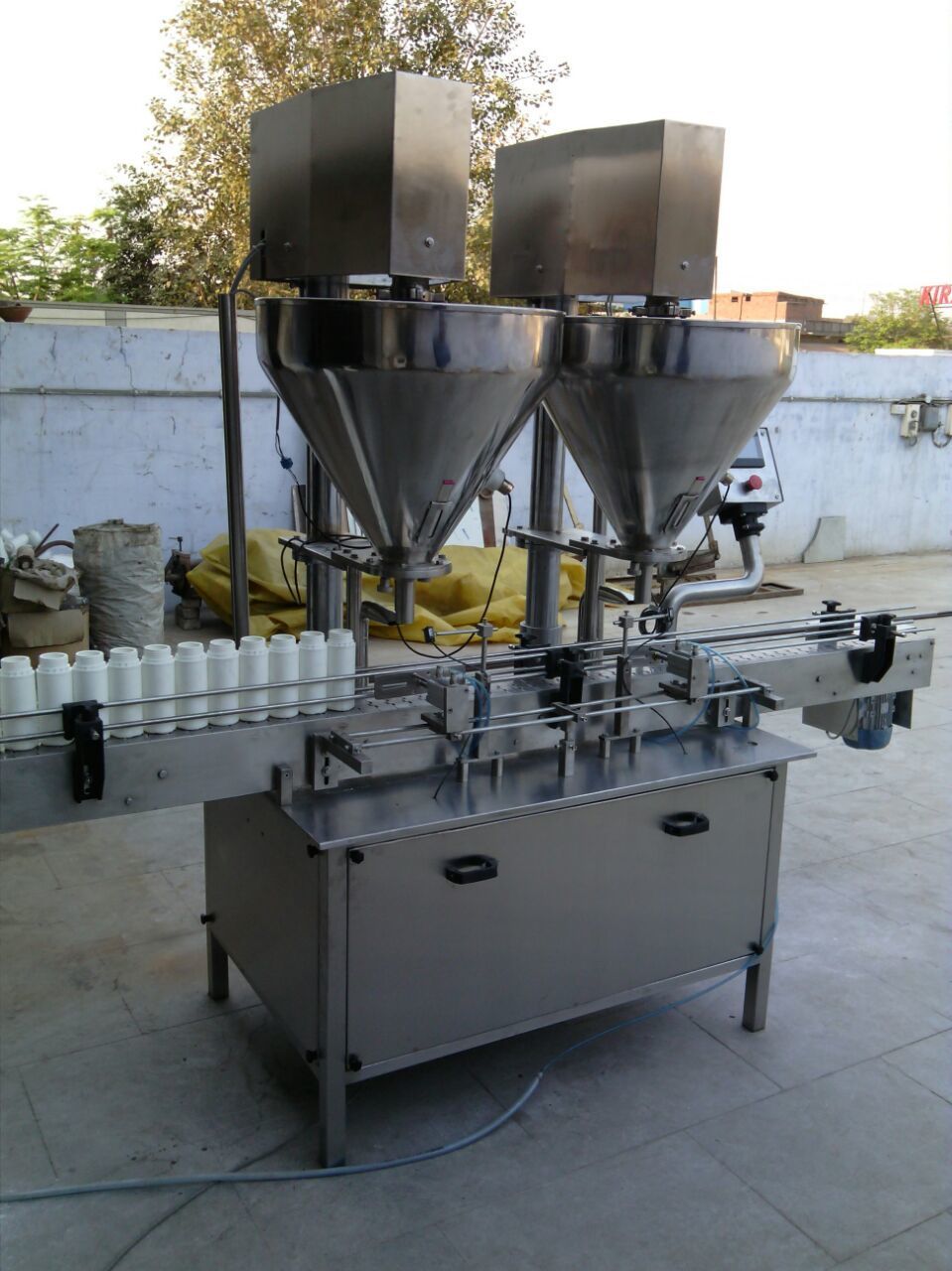
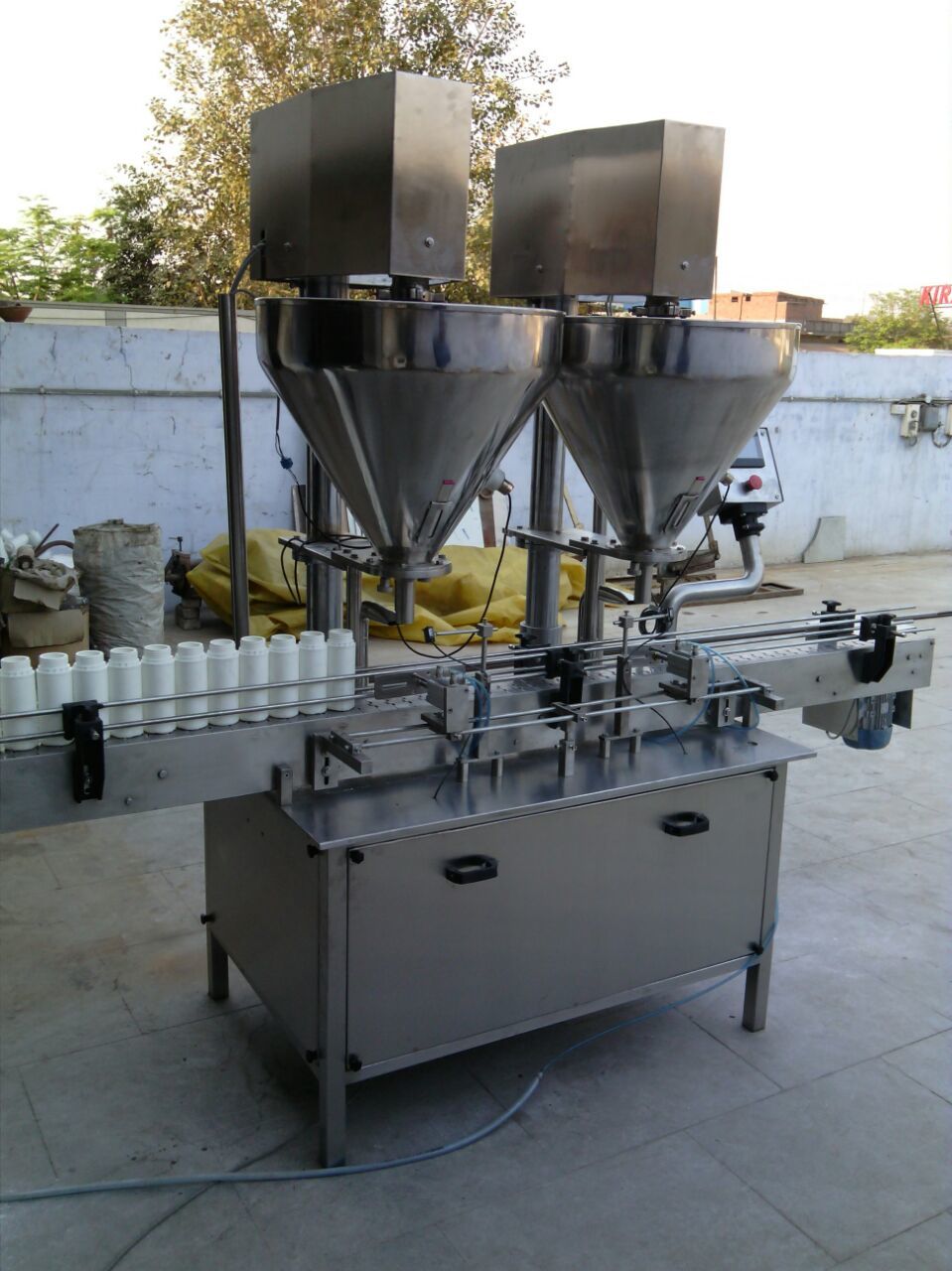
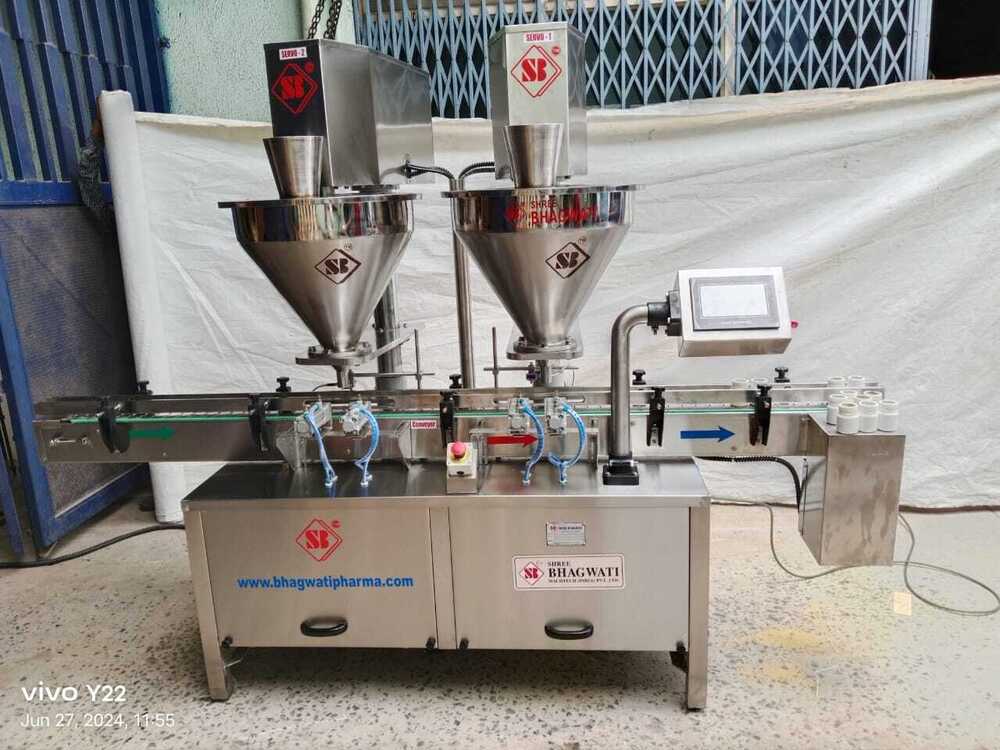
The incoming dry bottle sterilizedis fed through the in feed Turn Table with suitably guided on the moving Delranflat conveyor belt at the required speed for feeding. There are two separatefilling head mounted on machine top plate in the same line. When bottle reachesto the first filling station, it will be held by the pneumatic bottle holder.Immediately it will be sensed by the bottle sensor as soon as it gets signalsfrom sensor magnetic clutch starts to rotate which is mounted on auger shaft.It will fill the desired amount of powder to the bottle through auger, whererotation time is previously saved in PLC control. After filling of first bottlepneumatic piston goes back and release the first bottle to move on conveyor, bythe same time second bottle also moves along with the first bottle in emptycondition. In second filling head same operation will be performed but thistime second bottle get filled and first bottle moves further for nextoperation. The main advantage of this machine is Pneumatic bottle holdingsystem is directly connected with Auger rotation, so till bottle get filledwith powder as per set value pneumatic system will not going to release thebottle.
State-of-the-Art Design
Our powder filling machine features computerized PLC control, offering intelligent operation and easy customization. Constructed with stainless steel, it remains robust and hygienic, meeting the rigorous requirements of powder-handling industries. This combination of technology and material ensures long-lasting performance and user-friendly maintenance.
Impressive Filling Range
Handle a diverse array of applications effortlessly, with the ability to fill powders from as little as 5 grams up to 1000 grams. From pharmaceuticals to food processing, its flexibility supports various business needs, improving productivity while keeping dosage accurate and consistent.
Trusted Supplier in India
As a reputable exporter, manufacturer, distributor, and supplier in India, we guarantee prompt service and expert support. Our automatic powder filling machines are tailored to enhance operational workflows for businesses of all sizes, delivering both efficiency and peace of mind.
FAQs of Automatic Powder Filling Machine:
Q: How does the Automatic Powder Filling Machine operate?
A: The machine utilizes an electric drive system and PLC control to automate the powder filling process. Simply set the desired parameters, and the machine precisely measures and dispenses powders ranging from 5 to 1000 grams into containers, ensuring accuracy and efficiency with minimal manual intervention.Q: What materials can be filled using this machine?
A: This machine is ideal for handling a variety of free-flowing and semi-free-flowing powders, including food, pharmaceutical, and chemical powders, thanks to its precision dosing and robust stainless steel construction.Q: When is it beneficial to use an automatic powder filling machine over manual methods?
A: An automatic powder filling machine is especially advantageous when handling medium to large volumes, as it significantly increases speed, improves accuracy, and minimizes labor costs compared to manual filling methods.Q: Where can this machine be installed for optimal performance?
A: The machine is suitable for installation in industrial settings such as manufacturing plants, packaging facilities, and laboratories. It requires a stable electric power source and should be placed on a level surface in a clean, dry environment for best results.Q: What is the process for setting up and using this powder filling machine?
A: To set up, connect the machine to a power source, adjust the filling parameters through the PLC touch interface, and load the powder into the hopper. After performing a quick calibration, the filling process can start, running automatically based on your specifications.Q: What benefits does the PLC control system offer?
A: The PLC control system allows for precise customization and repeatable operation. It enhances accuracy, facilitates quick changeovers between different products, and reduces the risk of human error, ultimately leading to higher productivity and consistent quality.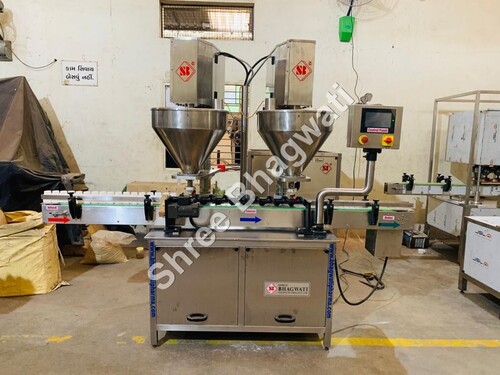
Tell us about your requirement

Price:
Quantity
Select Unit
- 50
- 100
- 200
- 250
- 500
- 1000+
Additional detail
Mobile number
Email

More Products in Powder Filling Machine Category
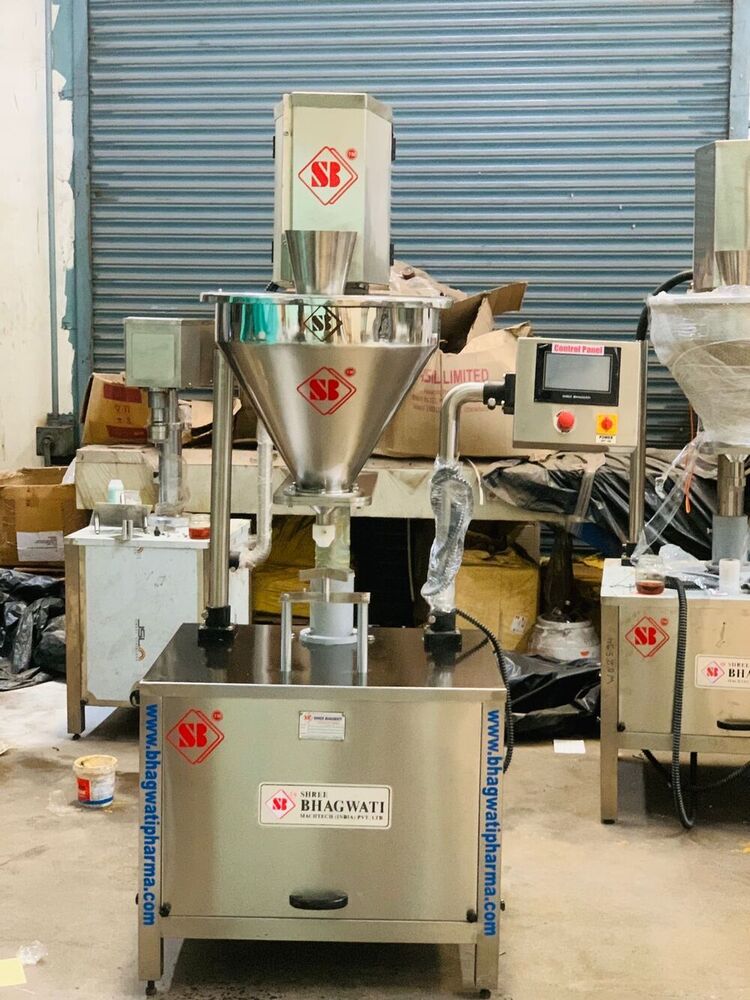
Semi Auto Auger Filling Machine
Price 375000 INR / Unit
Minimum Order Quantity : 1 Piece
Computerized : No
Automatic Grade : SemiAutomatic
Warranty : 1 Year warranty
Material : Stainless steel
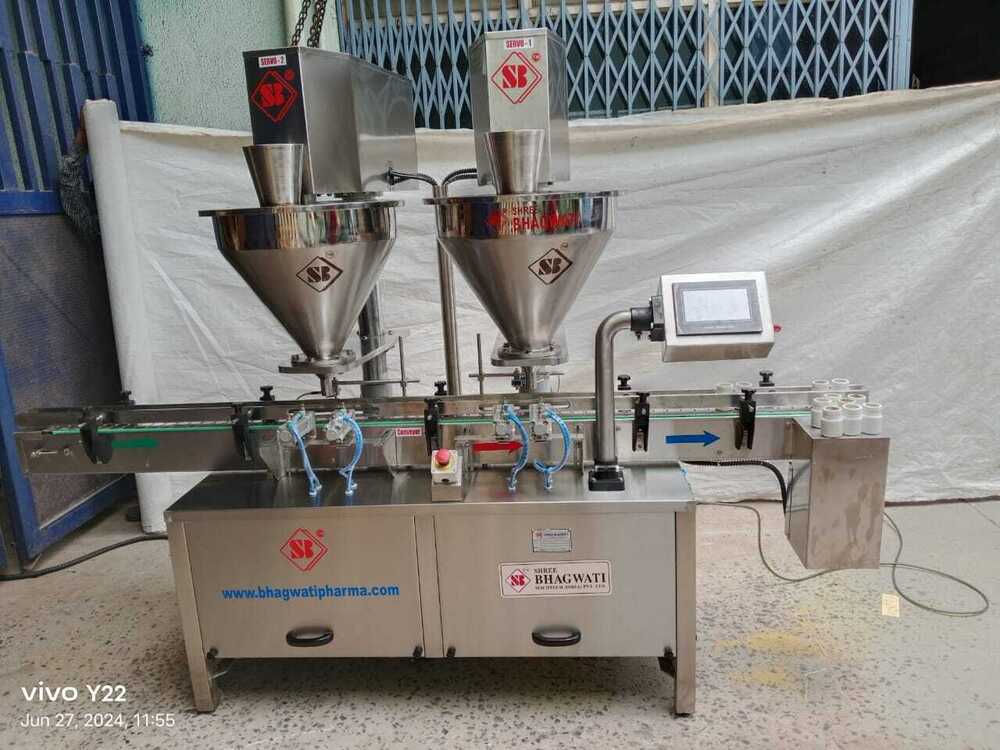
Automatic Two Head Powder Filling Machine
Price 1100000 INR / Unit
Minimum Order Quantity : 1 Unit
Computerized : Yes
Automatic Grade : Automatic
Warranty : 1 year
Material : Stainless steel
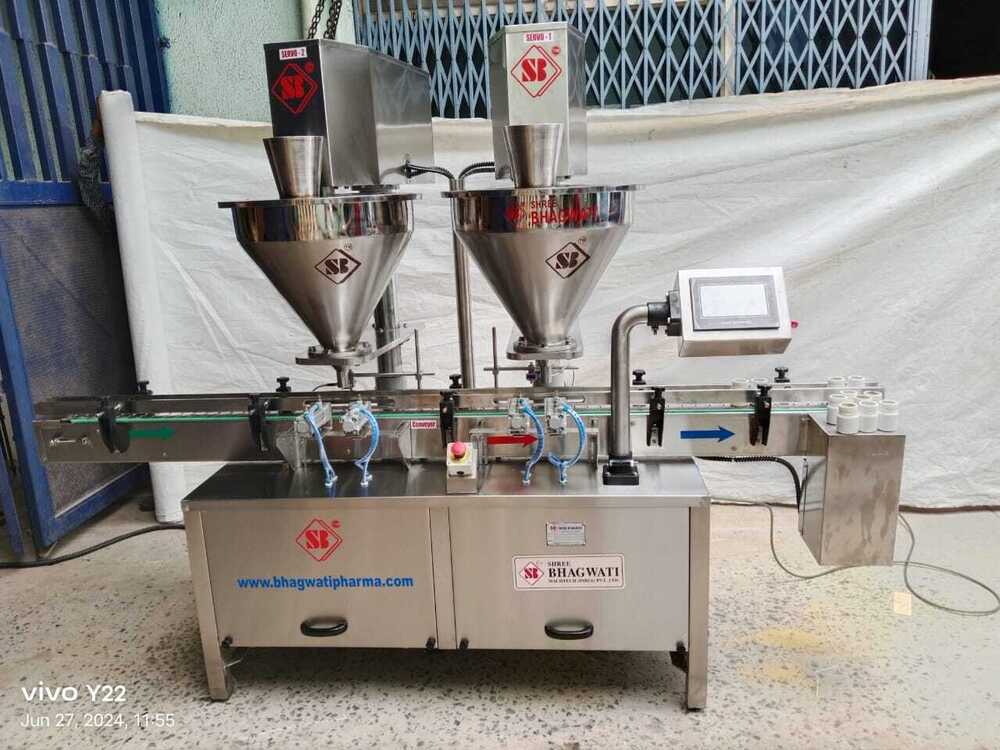
Double Head Auger Type Powder Filling Machine
Price 1200000 INR / Unit
Minimum Order Quantity : 1 Piece
Computerized : No
Automatic Grade : Automatic
Warranty : 1 Year
Material : SS
Auger Powder Filling Machine
Price 600000.00 INR / Unit
Minimum Order Quantity : 1 Piece
Computerized : No
Automatic Grade : Automatic
Warranty : 1 Year
Material : SS

Contact Us

- Plot No. 2802, ROAD NO - 4 E, Near Ramol Char Rasta, Phase-IV, GIDC, Vatva, Ahmedabad - 382445, Gujarat, India
- Phone : 91-79-22770475
GST : 24AANCS9768F1ZQ

- Mr Arjun Rao (CEO)
- Mobile : +917069001605
- contact@bhagwatipharma.co.in
- Direct No. : +917069001605, +917069001607
MFG PLANT ADDRESS
Manufacturing Unit - 1 : Plot No. 2802, Road No. 4 E, Opp, Airway Surgical, Near Winflex Ltd, Ramol Cross Roads, G.I.D.C, Phase 4, Vatva, Ahmedabad - 382445, Gujarat, India
Manufacturing Unit - 2 : Plot No. 5/22, Phase-1, G.I.D.C., Vatva, Ahmedabad - 382445, Gujarat, India
Manufacturing Unit - 3 : Plot No. 708-P/18 Mukti Chokdi, Near Ramdev Chokdi, Opp. Gujarat Insecticides Ltd (GIL), G.I.D.C. Ankleshwar, Dist- Bharuch, Gujarat - 393002, India
Manufacturing Unit - 4 : Plot No. 250, Near Verni Gestech, Opp. Fire Station, GIDC Estate, Ankleshwar, Dist- Bharuch, Gujarat - 393002, India

|


Our Products
- Blenders
- Ribbon Blender Machine
- Tablet Press
- Labeling Machine
- Sticker Labelling Machine
- Shrink Sleeve Applicator
- Label & Sticker Labeling Machine
- Lotion Manufacturing Plant
- Cream Manufacturing plant
- Ointment Cream Manufacturing Plant
- Gel Manufacturing Plant
- Dry and Wet Granulation Line - Tablet - Capsule
- Vibro Sifter
- Dry & Wet Granulation Machine
- Dry and Wet Tablet Granulation Line
- Rotocone Vacuum and Tray Dryer
- Dryers
- Gel Toothpaste Manufacturing Plant
- Toothpaste Manufacturing plant
- Dental Cream Toothpaste Manufacturing Plant
- Dental Toothpaste Manufacturing Plant
- Liquid Detergent Manufacturing Plant
- Oral Syrup Manufacturing Plant
- Filter Press
- Inline Homogenizer
- Liquid Oral Manufacturing Plant
- Syrup Manufacturing Plant
- Plastic and Alluminum Tube Filling Machine
- Automatic Ointment Filling Machine
- Automatic Toothpaste Filling Machine
- Planetary Mixer
- Automatic Liquid Packing Machinery
- Capping Machine
- Automatic Filling Machine
- Vial and Bottle Inspection Machine
- Gel Filling Machine
- Liquid Detergent Filling Machine
- Liquid Filling Machine
- Semi Automatic Powder Packing Machinery
- Automatic Powder Packing Machinery
- Automatic Packaging Machine
- Syrup Filling Machine
- Automatic Lotion Filling Machine
- Turn Table - Scrambler & Un-scrambler Machine
- Vial & Bottle Washing Machine
- Vial Powder Filling Machine
- Powder Filling Machine
- ROPP and Screw Capping Machine
- Bottle and Vials Liquid Filling Machine
- Semi Automatic Liquid Packing Machinery
- Sauce-Ketch Up Manufacturing Plant
- Capsule and Tablets Strip Packing Machine
- Lube Oil Blending Plant
- Capsule and Tablets Blister Packing Machine
- Water Treatment Plant
- Industrial Conveyor System
- Industrial Machinery
- Heat Exchangers
 Send Inquiry
 Send SMS
Let's talk business
Please take a moment to complete this form and a business representative will get back to you swiftly
SHREE BHAGWATI PHARMA MACHINERY COMPANY
All Rights Reserved.(Terms of Use)
Developed and Managed by Infocom Network Private Limited.
Developed and Managed by Infocom Network Private Limited.

